
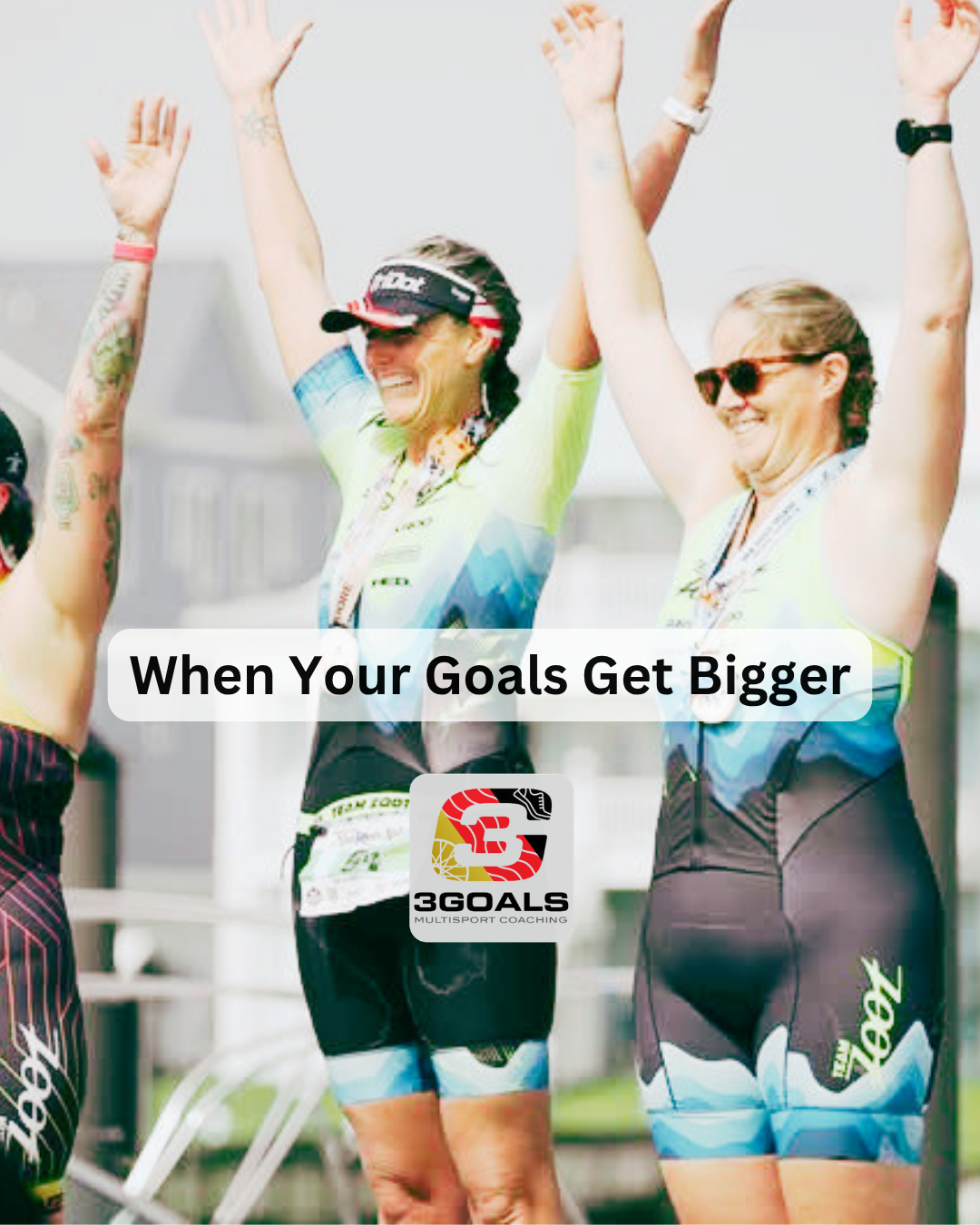
When Your Triathlon Goals Get Bigger: How to Adjust Without Overdoing It
Sometimes your triathlon goals change quietly.
You finish a race and realize you want to do it better next time.
You sign up for a longer distance and suddenly the goal feels more real.
You start training consistently and begin to wonder what might be possible if you stopped winging it.
Other times, your goals change very loudly.
Recently, my own season shifted in a big way. I went from casual training with my biggest races sitting in late fall to suddenly looking at an A race in 13 weeks and asking myself a very different question:
What needs to change if I want to take a real shot at qualifying for 70.3 Worlds?
That is a fun question.
It is also a slightly terrifying question.
And that is the thing about bigger goals. They can be exciting, motivating, and meaningful—but they can also tempt you into doing too much, too fast, too soon.
The answer is not panic-training.
The answer is learning how to adjust with intention.
What Should You Do When Your Triathlon Goals Get Bigger?
When your triathlon goals get bigger, the first step is not to immediately add more training. The first step is to identify what actually needs to change. That may include your training structure, recovery, everyday nutrition, race fueling, strength, mobility, consistency, race execution, or mindset.
A bigger goal does not always require a bigger training schedule.
It usually requires a smarter, more complete one.
Maybe your bigger goal is not a world championship qualifying attempt. Maybe it is:
- Finishing your next race stronger
- Moving from sprint to Olympic distance
- Training for your first 70.3
- Improving your run off the bike
- Finally learning how to pace the bike well
- Chasing a PR
- Racing with more confidence
- Showing up prepared instead of hoping for the best
Whatever the goal is, the shift matters.
Because the moment your goal gets bigger, your training decisions need to become more intentional.
Bigger Goals Do Not Mean Everything Has to Change
This is where athletes often get into trouble.
They set a bigger goal and immediately assume they need to change everything.
More workouts. More intensity. More miles. More gear. More pressure. More “I should probably be doing something extra.”
That kind of reaction makes sense emotionally, but it is not always productive.
If you have been training consistently, you probably do not need to throw your whole plan away. You need to look at what is already working and what needs to be sharpened.
A bigger goal does not mean you suddenly become a different athlete overnight.
It means you become more specific.
Step 1: Define What the Bigger Goal Actually Requires
Before changing your training, get clear on what the new goal demands.
Not emotionally.
Practically.
Ask yourself:
- What distance am I training for?
- How much time do I have?
- What fitness do I already have?
- What is my biggest limiter right now?
- What race conditions should I prepare for?
- What does success actually look like?
- What can I realistically commit to without wrecking the rest of my life?
This is where “I want to do better” becomes something useful.
For example, “I want to be faster” is vague.
“I need to bike strong without destroying my run” is actionable.
“I want to qualify” is motivating.
“I need to improve execution, sharpen race-specific fitness, fuel the work, and protect recovery over the next 13 weeks” is a plan.
The more specific the goal becomes, the easier it is to make smart training decisions.
Step 2: Identify What Does Not Need to Change
This is the part athletes skip.
When goals get bigger, it is tempting to focus only on what you need to add. But one of the smartest things you can do is identify what is already working.
Maybe you already have good consistency.
Maybe your swim is solid enough.
Maybe your easy effort discipline has improved.
Maybe your fueling is finally becoming more reliable.
Maybe your long rides are going well.
Do not throw away the strengths that got you here!
Bigger goals are not built by constantly starting over.
They are built by protecting what works and improving what matters most.
Step 3: Find the Real Limiter
Not every athlete needs the same adjustment.
One athlete may need more bike durability.
Another may need better run consistency.
Another may need open water confidence.
Another may need to stop overbiking.
Another may need to fuel properly.
Another may need recovery more than another workout.
That is why “train more” is not always the answer.
If your biggest limiter is pacing, adding more intensity may not fix it.
If your biggest limiter is fueling, another long ride without a nutrition plan may only reinforce the problem.
If your biggest limiter is consistency, an aggressive schedule may make things worse.
If your biggest limiter is recovery, adding more work may be the exact thing that keeps you stuck.
The goal is not to do more random training.
The goal is to solve the problem that is most likely to stand between you and the race you want.
Step 4: Adjust Training Without Panic-Training
Panic-training is what happens when your goal suddenly feels real and your brain decides you are behind.
So you start adding workouts.
You push easy days.
You turn every session into a test.
You squeeze in “just a little extra.”
You compare your training to everyone else’s.
You forget that adaptation requires recovery.
Panic-training feels productive in the moment because you are doing something.
Panic-training often shows up as pushing too hard on the days that are supposed to be easier, which is why learning how to make easy days easy matters even more when your goals get bigger.
But bigger goals require more than effort. They require discipline.
And sometimes the most disciplined thing you can do is not add more.
It is doing the right work, recovering from it, and repeating that process long enough for it to matter.
Step 5: Make the Training More Specific
When your goal gets bigger, your training may need to become more specific to the demands of the race.
That might mean practicing race-day pacing, dialing in bike effort, running off the bike more intentionally, testing nutrition during key sessions, and preparing for the specific conditions of your race.
This is where training shifts from general fitness to purposeful preparation.
This is where a race execution plan becomes more useful than simply hoping you feel good on race day.
You are no longer just “getting workouts done.”
You are preparing for the specific demands of the goal in front of you.
That does not mean every workout needs to be hard.
It means every workout needs a reason.
Step 6: Protect Recovery Like It Is Part of the Goal
Because it is.
The bigger the goal, the more important recovery becomes.
Not less.
When athletes get excited about a bigger goal, recovery is often the first thing they sacrifice. Sleep gets shorter. Easy workouts get faster. Strength work gets crammed in. Rest days become “just an easy spin.”
Then they wonder why they feel flat.
Fitness gains do not happen during the workout. The workout creates the signal. Recovery allows your body to adapt.
If your goal got bigger, recovery did not become optional.
It became strategic.
Step 7: Fuel Like You Expect Your Body to Perform
When athletes get serious about a bigger goal, they often focus on the workouts first.
The long rides. The intervals. The race-specific sessions. The key runs off the bike.
Those matter.
But if you are asking your body to do more focused work, you also need to support that work with better everyday fueling.
That does not mean chasing perfection with your nutrition. It means paying attention to whether your body has what it needs to adapt, recover, and perform.
For many athletes, bigger goals require more intention around:
- Eating enough overall
- Getting enough protein to support recovery
- Using carbohydrates around harder or longer workouts
- Staying hydrated throughout the day
- Replacing sodium and fluids when training in heat
- Avoiding the “train hard, underfuel, feel flat” cycle
- Practicing race nutrition before race day
Race-day nutrition matters, but it does not exist in isolation.
Your race fueling plan is built on the habits you practice in training.
If you are underfueling during the week, skipping recovery meals, or treating carbs like the enemy while expecting your body to produce performance, eventually your training will let you know.
And usually not in a cute way.
Bigger goals do not mean you need to make food complicated.
They do mean fueling has to become part of the plan.
Step 8: Rebuild Your 3 Goals
When your race goal changes, your 3 Goals should change too.
This is one of my favorite ways to keep a bigger goal from becoming an all-or-nothing pressure cooker.
A bigger goal can be exciting, but if there is only one definition of success, race day gets very heavy very quickly.
Instead, build a range.
For example:
Happy Goal: Show up prepared, execute the plan, and stay mentally engaged even when the race gets hard.
Super Happy Goal: Race with strong pacing, steady fueling, and a confident run.
Rockstar Goal: Have the kind of day where your preparation, execution, and fitness come together for the bigger result you are chasing.
This gives you something to fight for without making the entire season feel like pass/fail.
Bigger goals should stretch you.
They should not steal the joy from the process.
Step 9: Let the Bigger Goal Change Your Priorities
When your goal gets bigger, your priorities may need to shift.
That does not mean your whole life has to revolve around triathlon.
It does mean you may need to be more honest about what supports the goal and what distracts from it.
For a focused build, you may need to ask:
- Which workouts matter most each week?
- Where do I need to protect sleep?
- Am I fueling enough to support the training I am asking my body to do?
- What habits support recovery?
- What do I need to stop adding?
- Where am I wasting energy?
- What decisions will make race day easier?
This is not about becoming obsessive.
It is about aligning your actions with the goal you say matters.
You can still have a life.
You just may need fewer random side quests.
f you are not sure how to organize your next training block, a Join 3G TriDot Kickstart can help you start with more structure and less guessing.
Step 10: Expect Some Discomfort
Bigger goals come with bigger emotions.
Excitement. Doubt. Motivation. Fear. Confidence. Second-guessing.
Sometimes all before breakfast.
That does not mean you chose the wrong goal.
It means the goal matters.
The key is not to wait until you feel completely confident. Confidence often comes from doing the work, seeing progress, and proving to yourself that you can handle the next step.
You do not need to feel fearless.
You need to stay engaged.
Step 11: Know When You Need More Support
A bigger goal often reveals the difference between having workouts and having a plan.
Workouts tell you what to do today.
A plan helps you understand why it matters, how it fits, when to adjust, and what to prioritize when life does not cooperate.
That support can matter a lot when the goal gets bigger.
Because the question is no longer just, “Can I complete the training?”
The question becomes:
“Am I doing the right work at the right time for the race I actually want?”
That is where coaching can help.
Not by making the goal feel more intimidating, but by making the path clearer.
Bigger Goals Should Not Mean Losing the Joy
This part matters.
When athletes decide they want more, they sometimes start treating the entire process like a job with their worth on the line.
Please do not do that.
You are allowed to care deeply and still enjoy it.
You are allowed to chase performance and still celebrate progress.
You are allowed to want a bigger result and still be proud of the smaller wins along the way.
The goal getting bigger does not mean the experience has to become miserable.
It means the training gets more intentional.
The decisions get more focused.
The plan gets more specific.
The fueling gets more supportive.
And the process asks you to grow into the athlete you are trying to become.
Final Thoughts: Adjust With Intention
When your triathlon goals get bigger, resist the urge to panic.
You do not need to overhaul everything.
You do not need to train like someone else.
You do not need to prove your commitment by making yourself exhausted.
You need to pause, assess, and adjust.
Define what the goal requires.
Protect what is already working.
Identify the real limiter.
Make the training more specific.
Fuel the work you are asking your body to do.
Recover like it matters.
Build goals that keep you grounded.
And then do the next right thing.
Bigger goals can be scary.
They can also be incredibly fun.
Especially when you have a plan that helps you chase them without losing yourself in the process.
Want Help Adjusting Your Training for a Bigger Goal?
If your goals have changed and you are wondering what your training should look like next, start with a Join 3G TriDot Kickstart based on your fitness, schedule, and race date.
You will get two months of structured training with no credit card required, so you can start training with more confidence and less guessing.
FAQ: When Your Triathlon Goals Get Bigger
Keep Reading
- How to Make Easy Days Easy
- Pacing for Beginners
- Race Day Calm
- Your First Tri Plan: 8 Weeks to the Start Line Without Burning Out
- First Triathlon Mistakes Beginners Make—and How to Avoid Them
- Join 3G TriDot Kickstart
In the Comments
Have your triathlon goals gotten bigger recently? What changed?
Leave a Reply