
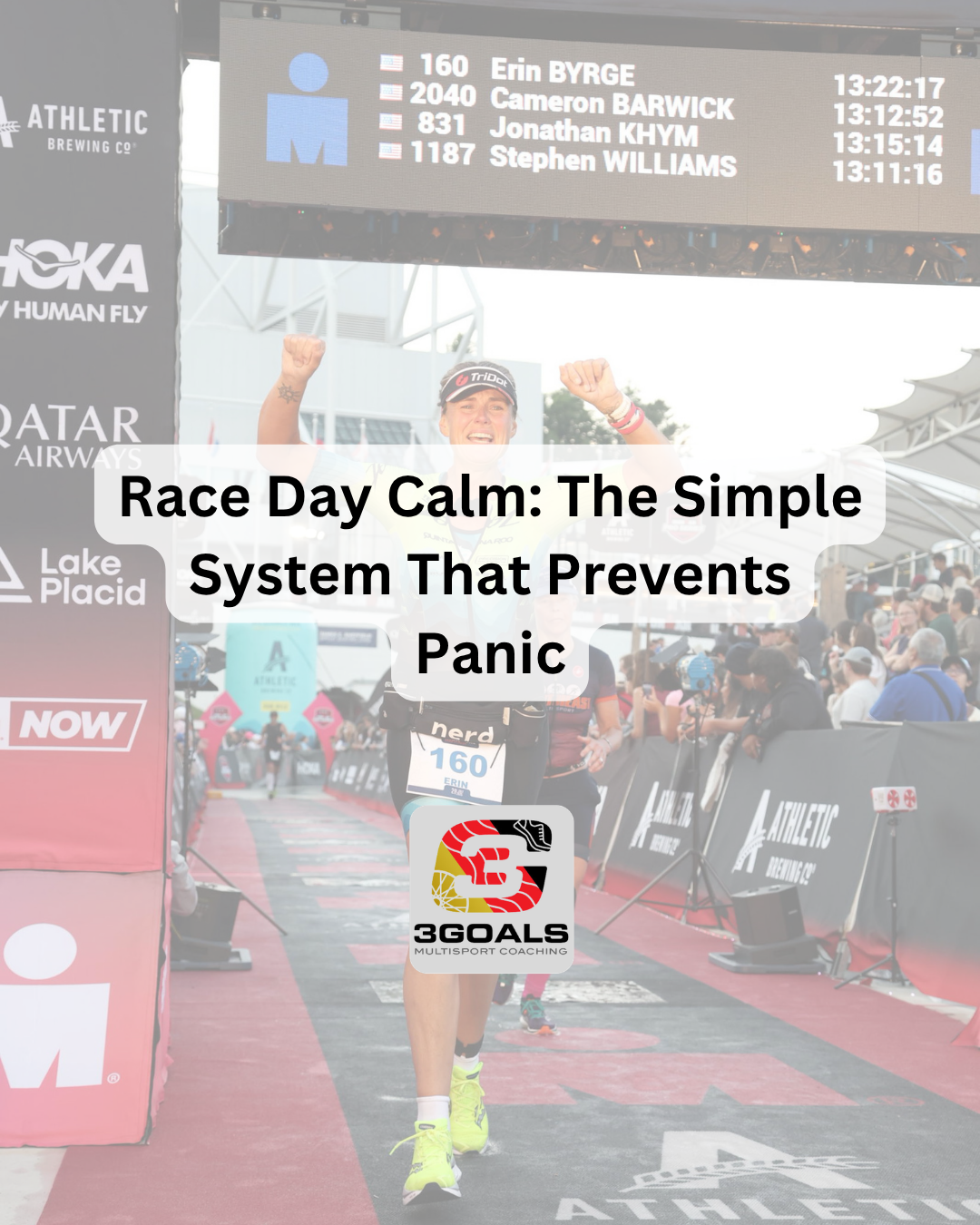
Race Day Calm: The Simple System That Prevents Panic
Race morning has a funny way of turning rational adults into chaos gremlins.
You’re missing a sock. Your goggles feel weird. Your bike computer won’t connect. You’re suddenly convinced you forgot something important (you probably didn’t). And the closer it gets to your start time, the more your brain goes, “WE ARE NOT READY.”
Here’s the truth: most race-day panic isn’t caused by fitness.
It’s caused by too many decisions, too late, with too much adrenaline.
So today I’m giving you the simplest system I know to create race day calm—even when things go sideways.
Quick answer (so you don’t have to scroll)
Race day calm comes from reducing decisions: prepare with a checklist, follow a repeatable race morning routine, and race with a short “defaults” plan (pace caps, fueling cues, and a reset script for problems).
Key takeaways
- Panic is usually a planning/decision problem, not a toughness problem.
- A simple triathlon race day checklist + routine removes 80% of stress.
- “Defaults” (your pre-made decisions) keep you calm when things go wrong.
- Don’t add extra workouts in race week—fresh beats fit.
Why race day panic happens (even to experienced athletes)
Panic shows up when you have:
- too many tasks
- not enough time
- unclear priorities
- and a brain full of adrenaline
Even confident athletes can spiral when one small thing feels off.
The goal isn’t to eliminate nerves. Nerves are normal.
The goal is to prevent the “now I’m making dumb choices” moment.
The simple system: PREP → ROUTINE → DEFAULTS
This is the system I want you to use:
- PREP: the days-before setup
- ROUTINE: the race-morning flow
- DEFAULTS: your pre-made decisions for the race itself
If you do these three things, you’ll feel calm because you’re not inventing your day on the fly.
Step 1: PREP (the days before)
Race calm starts the days before (1 day for local short races, longer if you are traveling). Your job is to make race morning boring.
Your #1 tool: Triathlon packing list
Use a checklist. Always.
Checklist = fewer forgotten items + fewer decisions + less stress.
If you don’t have one, use Triathlon packing list.
The “3 piles” method (stupid simple, works every time)
Create three piles the day before:
- Swim pile
- Bike pile
- Run pile
Then create a 4th mini-pile:
- “Before you leave” pile (watch, HR strap, nutrition, sunglasses, sunscreen, body glide)
Pack it the same way every time. Consistency is calming.
Your rule: nothing new on race day
No new:
- shoes
- nutrition
- goggles
- kit
- tech settings
If it hasn’t been used in training, it doesn’t show up on race day.
Step 2: ROUTINE (race morning flow)
Your triathlon race morning routine should be repeatable and boring.
Here’s a simple one that works:
The 60–45–30–15 routine
60 minutes out
- Arrive, exhale, orient yourself
- Bathroom line (do this early)
- Start sipping fluids you’ve practiced with
45 minutes out
- Set up transition (same order every time)
- Fill bottles / place nutrition
- Quick equipment check (tires, brakes, Garmin/power connection)
30 minutes out
- Get in your wetsuit (if needed)
- Short warm-up + breathing calm-down
- Review 3 cues for the day (more on this below)
15 minutes out
- Final bathroom if needed
- Goggles/ cap check
- Start line positioning
- One job: stay calm
The point is not that this is perfect.
The point is: you always do it the same way so your brain stops panicking.
Step 3: DEFAULTS (pre-made decisions for the race)
This is the part that prevents panic mid-race.
When something goes wrong, your brain wants to improvise. Improvising with adrenaline is how people:
- go out too hard
- skip fueling
- chase speed
- spiral mentally
- blow up
Defaults are your “if-then” plan.
Default #1: your effort cap
Your default is: “I will not exceed my effort cap early.”
Examples:
- Swim: calm rhythm, long exhale
- Bike: steady effort, no speed chasing
- Run: start easier than you think, then build
If you tend to chase data, go read None of Your Business: The Data That’s Wrecking Your Workouts and set your screens up so you don’t sabotage yourself.
Default #2: your fueling cue
Your default is not “eat when you feel like it.”
Your default is:
- start fueling early
- keep it steady
- don’t fall behind
Race day calm often comes down to blood sugar calm.
Default #3: your reset script (say it out loud)
When something goes wrong, you need one sentence you can repeat:
“Handle the problem. Breathe. Back to the plan.”
That’s it. That’s the script.
The moment you start negotiating (“this is ruined, I can’t, I’m done”), your brain takes over. Reset scripts interrupt the spiral.
The sneaky panic trigger: doing “extra” in race week
This is the race-week trap:
- your plan says easy
- you feel restless
- your friends are doing more
- you decide to “just add a little”
And suddenly you’re carrying fatigue into race day.
If you need this reminder: read Stop Training Like Everyone Else: Why Your Plan Works (If You Let It).
Fresh beats fit. Every time.
Race week isn’t where you gain fitness.
Race week is where you protect the fitness you already built.
What to do when something goes wrong (because it will)
Race day isn’t perfect. That’s normal.
Here’s the calm checklist when something goes sideways:
- Name it: “This is a small problem.”
- Fix only what needs fixing (no over-correcting)
- Breathe: exhale longer than you inhale (calms the nervous system)
- Return to defaults: cap + fuel + reset script
- Keep racing
The best racers aren’t problem-free.
They’re problem-solvers.
Want a plan that builds race-day confidence?
A good plan does more than build fitness. It builds trust:
- you practice the right effort
- you rehearse pacing
- you build consistency
- you show up ready
If you want a plan that removes guesswork and helps you show up calm and prepared, start with Join 3G TriDot Kickstart
FAQs
How do I calm race day nerves before a triathlon?
Use a checklist, follow a repeatable race morning routine, and focus on controllables: breathing, setup, and your first few minutes of effort.
What should I do if something goes wrong on race day?
Name it as a small problem, fix only what you can control, take a few long exhales, and return to your default plan (pace cap + fueling + reset script).
What is a good triathlon race morning routine?
A simple 60–45–30–15 minute routine works well: arrive early, set up transition in the same order, warm up calmly, and reduce last-minute decisions.
How do I avoid panic during the swim?
Focus on long exhales, a calm rhythm, and a reset cue. If anxiety spikes, slow down, exhale fully, and return to your plan rather than fighting the water.
Should I train extra in race week if I feel good?
No. Extra training in race week adds fatigue without adding fitness. Protect freshness so you can race well.
More Questions? Drop them in the comments.
What’s your biggest race-day stressor—packing, transition setup, tech issues, swim nerves, or pacing? Ask it in the comments and I’ll help you build a calm plan.
Leave a Reply