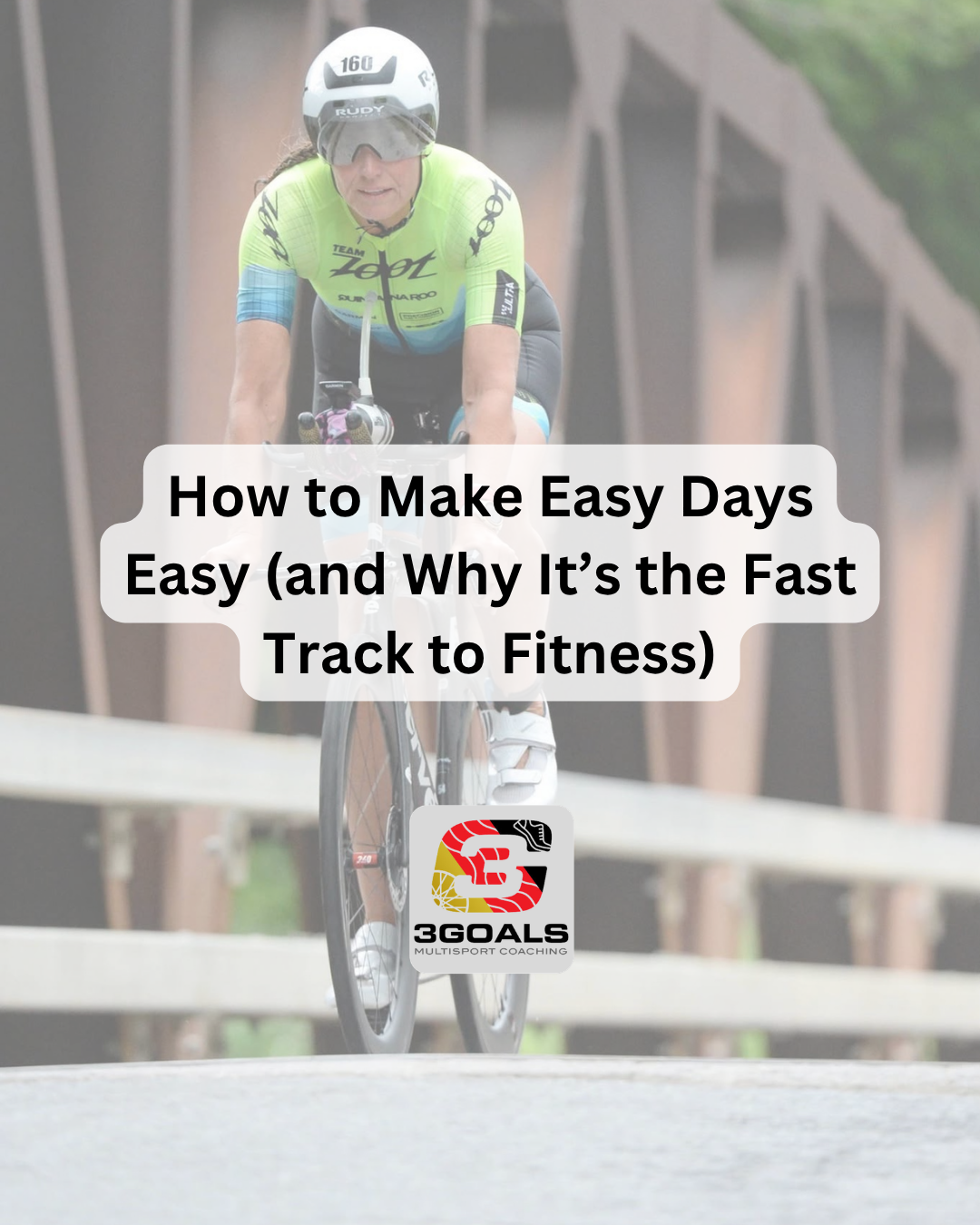
How to Make Easy Days Easy (and Why It’s the Fast Track to Fitness)
If you’ve ever finished an “easy” workout and thought, “Why did that feel kind of hard?” …you’re not alone.
This is one of the biggest reasons triathletes get stuck:
They don’t train too little. They train too medium.
And the fastest way to get fitter (without burning out) is simple:
Make your easy days easy.
Quick answer (so you don’t have to scroll)
Keeping easy sessions truly easy—mostly Zone 2 training—builds your aerobic engine, improves recovery, and lets you execute quality workouts when they matter. Easy days are where your fitness compounds.
Key takeaways
- Easy days should feel controlled, conversational, and sustainable.
- Easy days are not “wasted”—they’re where aerobic base training happens.
- If you push easy days too hard, you drift into the gray zone and stall progress.
- Simplify your data screens so you don’t chase numbers on easy sessions.
Why easy days are the fast track to fitness
This sounds backwards to a lot of motivated athletes. We equate “hard” with “effective.”
But most endurance fitness is built through:
- aerobic capacity (your engine)
- durability (your ability to handle training week after week)
- recovery (so you can absorb the work)
That’s what easy days give you.
Easy days are where you build the base that supports:
- faster paces at the same heart rate
- stronger bike power at the same effort
- better run durability with less soreness
- the ability to actually show up for quality sessions
This is aerobic base training. It’s not flashy, but it works.
The gray zone problem (and how easy days create it)
The gray zone is the “kind of hard” middle where you’re:
- not easy enough to recover
- not hard enough to improve
If you haven’t read it yet, Not Easy Enough to Recover, Not Hard Enough to Improve: The Gray Zone Trap explains why this is so common.
Here’s the simplest way to spot gray zone creep:
- your easy days feel like work
- you don’t feel fresh for hard days
- you’re always slightly tired
- your performance plateaus
Most of the time, the fix isn’t “more grit.”
It’s better separation between easy and hard.
What “easy” should feel like (Coach Erin definition)
Easy is not a pace. Easy is an effort.
Easy should feel like:
- you can talk in full sentences
- your breathing is steady and controlled
- you finish feeling like you could do more
- your body feels better after 10–15 minutes, not worse
If your easy run feels like you’re “holding back” …good.
That’s the point. Easy is what lets you train again tomorrow.
The biggest reasons easy days become hard days
Let’s be honest—this isn’t a knowledge problem. It’s a behavior problem.
1) You start too fast
The first 10 minutes are the danger zone. You feel good, your legs are springy, your brain says, “Let’s go.”
Fix: start intentionally slow for 8–10 minutes, then settle in.
2) You chase pace/speed
Pace and speed are the quickest ways to turn easy into steady.
Wind, hills, fatigue, and temperature all change what “easy pace” looks like.
This is why I’m such a fan of the mindset in None of Your Business: The Data That’s Wrecking Your Workouts. Some numbers are none of your business during an easy session.
3) You train like your friend’s plan
Your buddy is doing more. Your group ride is pushing. Your run club turns “easy” into a tempo sandwich.
Fix: join the fun, but protect your plan. You can run the warmup, ride the first hour, or do the social miles—then peel off when your workout is done.
If you need the reminder in bold: Stop Training Like Everyone Else: Why Your Plan Works (If You Let It).
4) You’re using the wrong screen
This is a game changer.
For heart-rate easy runs:
- show only HR (and maybe lap time)
- hide pace
- hide distance
- hide everything that tempts you to “perform”
For easy bikes:
- remove speed from your main screen
- use power (best) or HR (next best)
If you’re constantly negotiating with your watch, you’re not training. You’re arguing.
How to make easy days easy in swim, bike, and run
Swim (easy = rhythm + technique)
Easy swims are for:
- relaxed exhale
- smooth rhythm
- controlled effort
- form focus
Easy doesn’t mean sloppy. It means calm.
If the swim makes you anxious, start with Fear Free Swim Plan and build confidence without panic.
Bike (easy = steady aerobic)
Easy bike sessions build fitness with low impact.
Easy bike should feel:
- steady pressure, not burning legs
- smooth cadence
- “I could do this for a while” effort
If you’re chasing speed on an easy day, you’re going to overcook it. Remove the speed. Ride the effort.
Run (easy = durability)
Easy running is where durability gets built, especially for beginners and masters athletes.
Easy run rules:
- start slower than you think
- keep it conversational
- allow walk breaks if needed (they can keep you in Zone 2)
- don’t “prove fitness” on an easy day
Your goal is to finish and feel like you could run again tomorrow.
A simple 7-day easy-day reset
If your training has felt heavy, try this for one week:
- Every easy session stays truly easy (Zone 2)
- One quality workout only—execute it, then stop
- No “bonus miles”
- One technique-focused swim
- One steady endurance bike
- One easy longer run
- Sleep + fuel like it matters
Most athletes feel better in a week. Most start improving again in two.
Want a plan that protects your easy days?
This is exactly why structured training works: it separates easy and hard on purpose so you can recover, adapt, and build week after week.
If you want a plan that helps you stay consistent with Zone 2 training and keeps you out of the gray zone, start with Join 3G TriDot Kickstart.
FAQs
How easy should an easy day feel?
Easy should feel conversational and controlled. You should finish feeling like you could do more, not like you need a nap.
What is Zone 2 training?
Zone 2 is easy aerobic effort where you can breathe steadily and hold a conversation. It builds endurance, durability, and recovery capacity.
Why do easy days make you faster?
Easy days build aerobic base training, improve fat oxidation and efficiency, and allow you to recover so you can execute quality sessions.
Is it okay if my pace is slower on easy runs?
Yes. Easy pace changes with heat, wind, hills, fatigue, and stress. The goal is the right effort, not a specific pace.
How do I stop turning easy runs into hard runs?
Hide pace, use heart rate or effort, start slower for the first 10 minutes, and avoid comparing your run to someone else’s.
More Questions? Drop them in the comments.
What’s your biggest “easy day” struggle right now—starting too fast, chasing pace, group workouts, or feeling like easy isn’t productive?
Keep Reading (Recommended Next)
• Not Easy Enough to Recover, Not Hard Enough to Improve: The Gray Zone Trap
• None of Your Business: The Data That’s Wrecking Your Workouts
• Stop Training Like Everyone Else: Why Your Plan Works (If You Let It)
• Join 3G TriDot Kickstart
Leave a Reply