
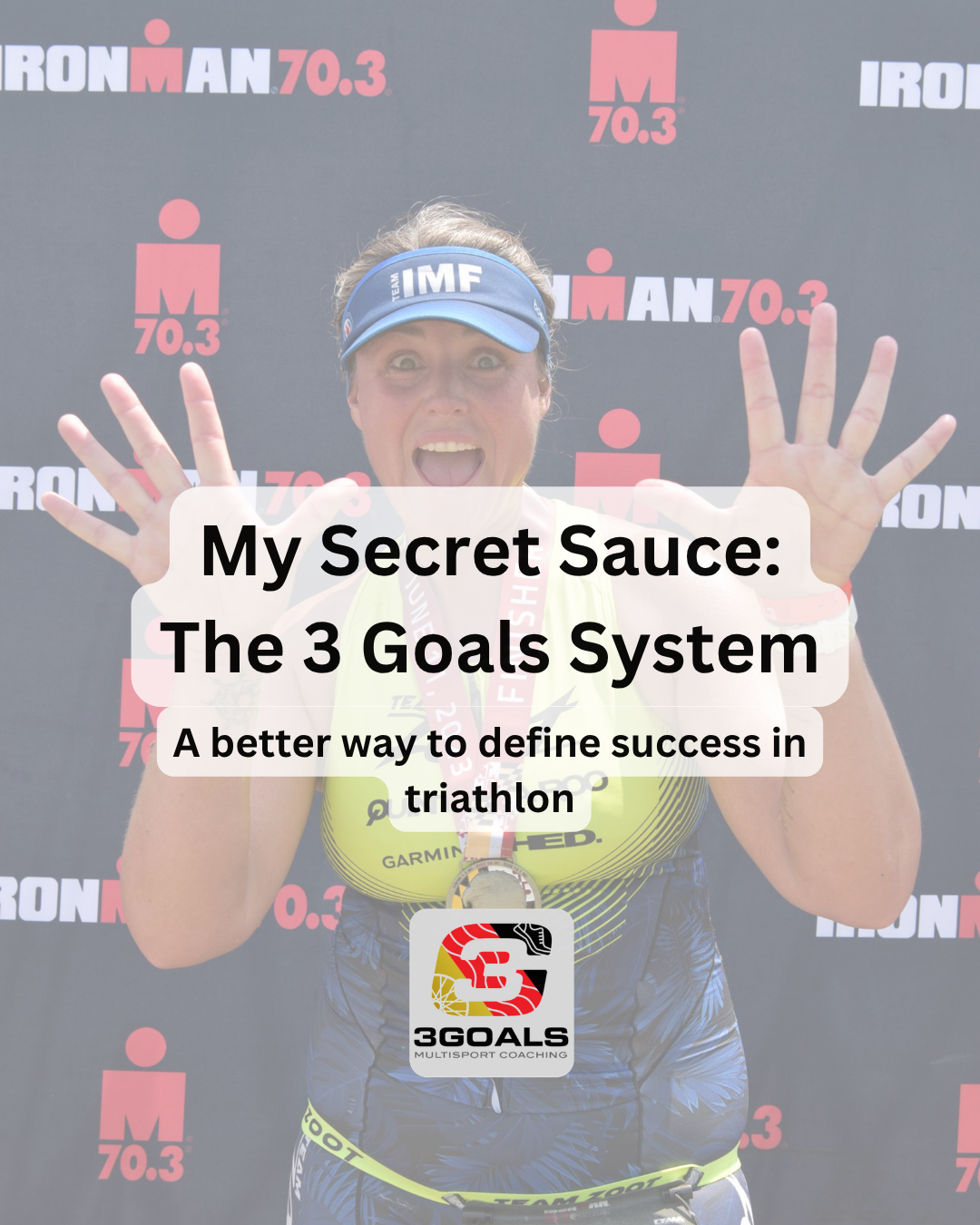
My Secret Sauce: The 3 Goals System for Training and Race Day
“What is your secret sauce that no one knows about?”
That question came from one of my athletes, Keith.
At first, I thought about all the little coaching details I could share. I could talk about pacing, race nutrition, workout execution, recovery, or the many small decisions that help an athlete arrive at the start line prepared.
But when I really thought about what sits at the heart of my own racing and my coaching, the answer was clear.
My secret sauce is the 3 Goals System.
It is the reason my business is called 3 Goals Multisport Coaching. It shapes how I help athletes prepare for races, evaluate performances, respond when things go wrong, and get through workouts that feel overwhelming.
The three goals are:
- Happy
- Super Happy
- Rockstar
The system allows athletes to be ambitious without turning every race into a pass-or-fail test.
It gives us a way to chase a big result while still protecting the joy of the experience. It also gives us somewhere meaningful to shift our attention when weather, illness, mechanical problems, fatigue, or the unpredictable nature of endurance racing changes the day.
That matters because we are not professional athletes.
We are not robots.
We are adults fitting training around work, family, travel, stress, sleep, responsibilities, and everything else life puts on the calendar.
Sometimes we feel like Rockstars.
Most of the time, we are doing our best in the Super Happy range.
And sometimes, simply starting, adapting, or refusing to quit gives us a very good reason to be Happy.
The Problem With Setting One Race Goal
When I was new to endurance sports, I set the same basic goal for almost every race:
Get a PR.
In the beginning, that worked.
New athletes often improve quickly because nearly everything they do creates a new stimulus. They become more comfortable with the distance, learn how to pace, improve their transitions, develop fitness, and gain experience.
For a while, PRs can happen frequently.
Then I reached a plateau.
I did not stop training. I had not suddenly become less committed. I simply reached the point where improvements were no longer automatic.
I could prepare well, race hard, and still not beat my previous time.
Because I had created only one definition of success, any race without a PR felt disappointing.
There was no middle ground.
I either hit the goal or I failed.
That is a difficult way to participate in a sport in which so many variables are outside our control.
Weather changes. Courses are different. Water conditions vary. Equipment malfunctions. Nutrition plans do not always cooperate. Life stress affects training. Bodies have good days and bad days.
Even when the race is executed well, the clock may not tell the whole story.
One goal creates an all-or-nothing mindset:
Hit the number: success.
Miss the number: failure.
For the typical Type A triathlete, that is an emotional trap.
How I Learned to Set Three Goals
A friend and fellow teacher introduced me to a different way of setting race goals.
She created three possible levels of success.
The biggest goal was the PR—the result that would make me feel like a Rockstar.
The next goal was still a stretch, even if it did not require a personal record.
The third was what she called the “better do” goal.
As in:
If I am paying the entry fee, setting the alarm, and getting up this early, I had better at least do this.
That approach immediately gave me more than one way to evaluate a race.
Over time, I adapted the system into the philosophy I use with my athletes today.
The top two goals are still performance-oriented. The biggest change has been the Happy Goal.
Instead of treating it as a minimum acceptable finish time, I usually encourage athletes to make it a process goal—something meaningful that remains at least partly within their control.
That evolution changed everything.
What Are Happy, Super Happy, and Rockstar Goals?
All three goals should feel possible when the athlete arrives at the start line.
They are not:
- One realistic goal
- One nearly impossible dream
- One consolation prize
The athlete should enter race day with genuine confidence that any of the three could happen.
The difference is how much needs to go right and how much of the outcome the athlete can control.
The Rockstar Goal
The Rockstar Goal is the big outcome.
It may be:
- A personal record
- A specific finish time
- An age-group podium
- A qualification for Nationals
- A qualification for a world championship
- A major breakthrough in one discipline
- A result that represents the best realistic expression of current fitness
Rockstar does not mean fantasy.
It should be supported by training, past performance, race conditions, course demands, and the athlete’s current fitness.
Because I coach through TriDot, my athletes have access to RaceX race predictions. We talk through those predictions, compare them with past performances, and consider what the athlete has demonstrated in training.
When an athlete has a qualification goal, we also discuss what that standard may require.
The Rockstar Goal should stretch the athlete, but the athlete should still believe:
If I execute well and the day comes together, this is possible.
The Super Happy Goal
The Super Happy Goal is also a strong performance goal.
It should not be something the athlete would shrug at.
It may be slightly more conservative than Rockstar, but it should still feel meaningful, exciting, and worthy of the work the athlete has done.
Examples could include:
- Finishing within a realistic target range
- Improving on a previous course result
- Running more of the final leg than in a past race
- Executing the bike strongly enough to preserve the run
- Reaching a performance benchmark even without earning the hoped-for qualification
- Completing a first long-distance race with solid pacing and nutrition
For some athletes, the difference between Super Happy and Rockstar is time.
For others, Rockstar may be a qualification or podium, while Super Happy represents a performance they would still be extremely proud to achieve.
The Happy Goal
The Happy Goal is the most personal goal.
It is usually process-oriented and based on something the athlete can influence even when the race does not unfold perfectly.
Examples of Happy Goals I have used with athletes include:
- Cross the finish line with a smile
- High-five every teammate seen on the run
- Follow the race nutrition plan
- Finish all planned nutrition on the bike
- Walk only through aid stations
- Thank the volunteers
- Stay mentally engaged when the race gets hard
- Soak up the atmosphere and community
- Solve problems without giving up on the day
- Finish feeling proud of the effort and decisions made
The athlete chooses the Happy Goal.
It must be something that would genuinely make that person happy.
For many long-distance athletes, “cross the finish line with a smile” is enough. It captures the desire to finish, remain present, and appreciate what the athlete has accomplished.
Others want something more data-driven, such as executing their nutrition plan or walking only at aid stations.
Neither approach is better.
The right Happy Goal is the one that gives that athlete a meaningful action to return to when race day becomes difficult.
A Happy Goal Is Not a Lower Standard
Competitive athletes sometimes resist this system because they worry the Happy Goal gives them permission to settle.
They hear “multiple goals” and assume we are softening expectations before the race has even begun.
That is not the purpose.
The Rockstar Goal is still there.
The Super Happy Goal is still there.
We are still training toward performance. We are still talking about predictions, previous results, qualification standards, pacing, nutrition, execution, and what the athlete is capable of doing.
The Happy Goal does not replace ambition.
It gives ambition a stronger foundation.
A good process goal usually supports the time goal.
An athlete who fuels appropriately is more likely to perform well.
An athlete who limits walking to aid stations is more likely to reach a strong run result.
An athlete who stays mentally engaged is more likely to adapt after something goes wrong.
An athlete who begins the race determined to soak up the experience may remain calmer and make better decisions than one who treats every split as a judgment.
The Happy Goal is not an escape route.
It is often the behavior that keeps the bigger goals possible.
Adults Do Not Have Enough Opportunities to Feel Proud
This is one of the things I tell athletes who still worry that a Happy Goal lowers the standard:
Adults do not have enough opportunities to feel proud of themselves.
We finish one responsibility and move directly to the next.
We meet a deadline and immediately think about another task.
We finish a workout and focus on the interval we missed.
We cross a finish line and look at the result before allowing ourselves to feel what we accomplished.
Triathletes can be especially good at moving the goalposts.
Run a PR? Maybe it should have been faster.
Complete a first 70.3? Start analyzing what went wrong.
Earn a podium? Look at the gap to first.
There is nothing wrong with wanting to improve. Reflection and data are useful.
But we should be able to learn from a performance without erasing everything worth celebrating.
A process-oriented Happy Goal gives athletes an opportunity to say:
I did what I said I would do, and I am proud of that.
That pride is not complacency.
It builds confidence.
It reminds the athlete that effort, execution, resilience, and presence matter—not only the number on the clock.
Expectation Is the Thief of Joy
I want my athletes to believe their Super Happy and Rockstar goals are possible.
I do not want them to expect that those outcomes are guaranteed.
There is an important difference between confidence and expectation.
Confidence says:
I have prepared for this, and I believe I am capable of doing it.
Expectation says:
If I do not get this result, the day was a failure.
Expectation can steal the joy from racing.
It can make an athlete so focused on one number that they fail to notice everything else happening around them.
It can turn a small setback into panic.
It can convince someone that the race is already lost when a split begins slipping.
The three-goal system allows athletes to stay confident and ambitious without demanding that race day follow a perfect script.
We chase Rockstar.
We work toward Super Happy.
And we protect Happy.
Your Goals Should Help You During the Race
The three goals are not merely categories we use to judge the result afterward.
They are decision-making tools during the race.
We can all look down at our watches and see a time goal getting away from us.
Maybe the swim took longer than expected.
Maybe the wind increased on the bike.
Maybe the heat is affecting run pace.
Maybe we lost time because of a mechanical issue, an unexpected bathroom stop, or a nutrition problem.
When the Rockstar Goal is no longer realistic, the athlete has a choice.
They can decide the day is ruined.
Or they can shift.
Moving from Rockstar to Super Happy is not giving up.
Moving from Super Happy to Happy is not failure.
It is adapting to the race that is actually happening instead of clinging to the race we imagined.
It is great to feel like a Rockstar sometimes.
But being Happy is good too.
How the 3 Goals System Helped Us at IRONMAN Texas
This year’s IRONMAN Texas gave both Miguel and me powerful examples of why the system matters.
Miguel experienced an incident very early in the swim that could easily have derailed his entire day.
When something goes wrong that early in a long race, it can feel as though months of preparation have disappeared before the event has truly begun.
But one disrupted section did not eliminate every goal.
Miguel kept moving forward. He reset mentally, continued racing, and ultimately reached his Super Happy Goal.
His day was not defined only by what happened in the swim.
The goals gave him somewhere else to direct his energy.
My day also changed dramatically after a bike crash.
A crash creates an obvious physical and emotional decision point. It would have been easy—and understandable—to treat it as the end of the race.
But my Happy Goal was still possible.
I could still finish.
I could still reach the line with a smile, even if that smile came through tears.
So I got back on my bike and continued.
That does not mean every athlete should continue after every crash. Safety must come first, and some circumstances absolutely require stopping.
But in my situation, I was able to continue safely, and the Happy Goal gave me a reason to do so.
The race I had imagined was gone.
The day still had meaning.
Using Super Happy to Protect the Day at Lake Placid
At IRONMAN Lake Placid 2025, my Rockstar Goal (sub-13 hours) began slipping away on the run.
At that point, I could have continued chasing a pace that was no longer appropriate and risked losing the Super Happy Goal too.
Instead, I shifted.
I used a walk-run ratio that helped me protect the next goal.
That adjustment was not an admission that I had stopped caring.
It was evidence that I still cared enough to race intelligently.
Once one goal is gone, the athlete does not have to throw everything else after it.
A strong race is not always the race in which nothing goes wrong.
Sometimes it is the race in which the athlete recognizes what has changed, adjusts quickly, and continues working toward the best remaining outcome.
The 3 Goals System Is Bigger Than Race Day
Although the system began as a way to set race goals, it now shapes how I think about training too.
Age-group athletes are not professional athletes, and we are not robots.
Some workouts go beautifully.
The body feels strong. The numbers are there. The athlete executes every interval and finishes with confidence. TrainX = 90+ #iykyk
That is a Rockstar day.
Other sessions are solid but not perfect.
The athlete does their best, completes the important work, makes a reasonable adjustment when necessary, and moves forward.
That is Super Happy training.
The majority of our workouts probably fall somewhere in this range.
Then there are days when starting is the victory.
The athlete may feel overwhelmed by an assessment, a long run, or a brick workout. They may need to break the session into smaller pieces. They may complete the warm-up, begin the key work, or modify the duration.
That can be a Happy day.
Not every workout needs to be extraordinary to contribute to progress.
Your training does not need to look perfect to be effective.
In fact, athletes who constantly turn easy sessions into tests often make training harder than it needs to be. Understanding why easy triathlon workouts can feel too easy—and why they still work can help remove some of that pressure.
Using Three Goals for an Overwhelming Workout
I sometimes use three goals when an athlete feels overwhelmed by an assessment, long run, or brick.
The goals might look like this:
Happy
Start the workout and complete the warm-up.
Super Happy
Complete the most important portion of the session, with reasonable modifications if needed.
Rockstar
Complete the full workout as written and execute it well.
This turns one intimidating task into a progression of possible wins.
The athlete does not have to mentally conquer the entire workout before taking the first step.
That said, we do not need three goals for every part of every workout or race. The system should reduce pressure and clarify priorities—not create nine new things to track.
Simplicity is part of what makes it useful.
Grace and Accountability Can Exist Together
I want my athletes to do their best.
I also want them to know they will receive grace from me when things do not go as prescribed.
Hopefully, over time, they learn to offer themselves that same grace.
Grace does not mean that execution no longer matters.
It does not mean ignoring patterns, skipping every uncomfortable session, or avoiding honest conversations about effort.
It means recognizing that one imperfect workout does not make someone a bad athlete.
It means we can review what happened without shame.
It means athletes can tell me the truth about a session instead of feeling pressure to make everything look better than it was.
Honest feedback gives us useful information.
Maybe the athlete was underfueled.
Maybe stress was unusually high.
Maybe the session was poorly timed.
Maybe the workout exposed a limiter we need to address.
Maybe the athlete simply had an off day.
We can use that information to make better decisions.
This is especially important when athletes set bigger triathlon goals. Bigger goals require intention, but they do not require treating every training session as proof of worth.
How to Create Your Own Three Race Goals
You do not need a coach or prediction tool to begin using the system.
Start with the following steps.
Step 1: Identify the Purpose of the Race
Ask yourself why this race matters.
Are you trying to:
- Finish your first triathlon?
- Set a personal record?
- Qualify for another event?
- Practice execution before a bigger race?
- Rebuild confidence?
- Enjoy a destination experience?
- Test new fitness?
- Complete a distance that once felt impossible?
The purpose will influence all three goals.
A first-time athlete will define Rockstar differently from someone chasing a world championship qualification.
Step 2: Review the Evidence
Consider:
- Recent training
- Previous race performances
- Current fitness
- Course profile
- Expected conditions
- Race distance
- Known strengths and limiters
- Available race predictions
- Qualification or podium standards, when relevant
Do not create a Rockstar Goal solely because the number sounds exciting.
Create it because your preparation suggests it could happen.
Step 3: Set the Rockstar Goal
Ask:
What result would represent an exceptional but realistic day?
Make it specific enough to guide you.
It could be a time, placement, qualification, PR, or another significant performance outcome. (PS – finishing is a significant outcome for many athletes!)
Step 4: Set the Super Happy Goal
Ask:
What strong result would still make me genuinely proud, even if the biggest goal does not happen?
This should remain a stretch.
Do not choose something you would secretly dismiss.
Step 5: Choose the Happy Goal
Ask:
What can I do during this race that would make the experience meaningful and help me feel proud, regardless of the final time?
Choose something you can influence.
Examples include:
- Execute the nutrition plan
- Stay within the pacing plan
- Walk only at aid stations
- Remain positive when things become difficult
- Thank volunteers
- Support teammates
- Finish smiling
- Stay present and appreciate the experience
Step 6: Make Sure All Three Feel Possible
Do not use the system to create one reasonable goal and two pretend goals.
You should arrive at the race believing all three could happen.
Your biggest outcome is not guaranteed, but it should be supported by evidence.
Step 7: Decide How You Will Shift
Before race day, ask:
- How will I recognize that Rockstar is slipping away?
- What decisions will protect Super Happy?
- What can I continue doing to reach Happy?
- What problems require adjustment?
- What situations require me to stop for safety?
This is not pessimistic planning.
It is race execution.
Step 8: Revisit the Goals During Race Week
Begin discussing your goals as general race preparation starts.
Then revisit them during race week.
By then, you have a clearer picture of:
- Current readiness
- Recent training
- Weather
- Course conditions
- Health
- Confidence
- Updated predictions
Confirm the goals, remind yourself why each one matters, and arrive at the start line ready to chase all three.
For newer athletes, understanding what to expect at your first triathlon and avoiding common first-triathlon mistakes can also make it easier to choose goals based on execution rather than fear.
How to Evaluate the Race Afterwards
After the race, begin with the Happy Goal.
Did you execute the behavior you chose?
Did you remain engaged?
Did you make decisions you are proud of?
Did you keep moving toward something meaningful when the original plan changed?
Then review Super Happy and Rockstar.
When those outcomes were not reached, ask:
- What worked?
- What did not?
- What data did the race give us?
- Was the goal appropriate?
- Did fitness, execution, conditions, or another factor affect the result?
- What can be practiced before the next race?
- What should remain unchanged?
Missing the biggest goals does not make the race useless.
It gives us information we can use to work toward Super Happy and Rockstar in a future event.
When the Happy Goal was reached, the day was still a success.
We can be proud and curious at the same time.
Success Does Not Have to Be All or Nothing
Triathlon asks a great deal from age-group athletes.
We train before work, after work, during lunch, on weekends, in heat, in cold, and around full lives.
We invest time, money, energy, emotion, and hope.
It is reasonable to want those efforts to produce results.
It is also reasonable to create more than one way to feel successful.
The 3 Goals System does not remove competition.
It helps us compete without allowing one number to own the entire experience.
It gives us confidence to chase a Rockstar performance.
It gives us a strong Super Happy result to protect when the perfect day begins slipping away.
And it gives us a Happy Goal that remains meaningful when endurance racing does what endurance racing often does: becomes unpredictable.
Some days, we are Rockstars.
Most days, we do our best without being perfect.
And sometimes, we adapt, persevere, finish through tears, or simply take the first step.
Those days deserve pride too.
It is great to feel like a Rockstar sometimes.
But being Happy is good too.
Create Your Three Goals
Before your next race, write down:
My Happy Goal:
What process or experience can I influence that will make me proud of the day?
My Super Happy Goal:
What strong performance would feel exciting and meaningful?
My Rockstar Goal:
What exceptional but realistic outcome am I prepared to chase?
Then decide how you will shift if the race changes.
A downloadable 3 Goals Race Planning Worksheet is coming soon to help you work through the full process.
You can also join the free 3G Multisport Community to share your goals, learn from other athletes, and get encouragement as you prepare for your next start line.
For more practical conversations about training, race execution, fueling, recovery, and mindset, visit the Coach Erin Says podcast.
FAQ: The 3 Goals System for Triathletes
Keep Reading
- When Your Triathlon Goals Get Bigger: How to Adjust Without Overdoing It
- Why Easy Triathlon Workouts Feel Too Easy—and Why They Work
- First Triathlon Mistakes Beginners Make—and How to Avoid Them
- What to Expect at Your First Triathlon
- Beginner Triathlon Starter Kit
- Explore Triathlon Coaching Options
What would your Happy, Super Happy, and Rockstar goals be for your next race?
Leave a Reply