
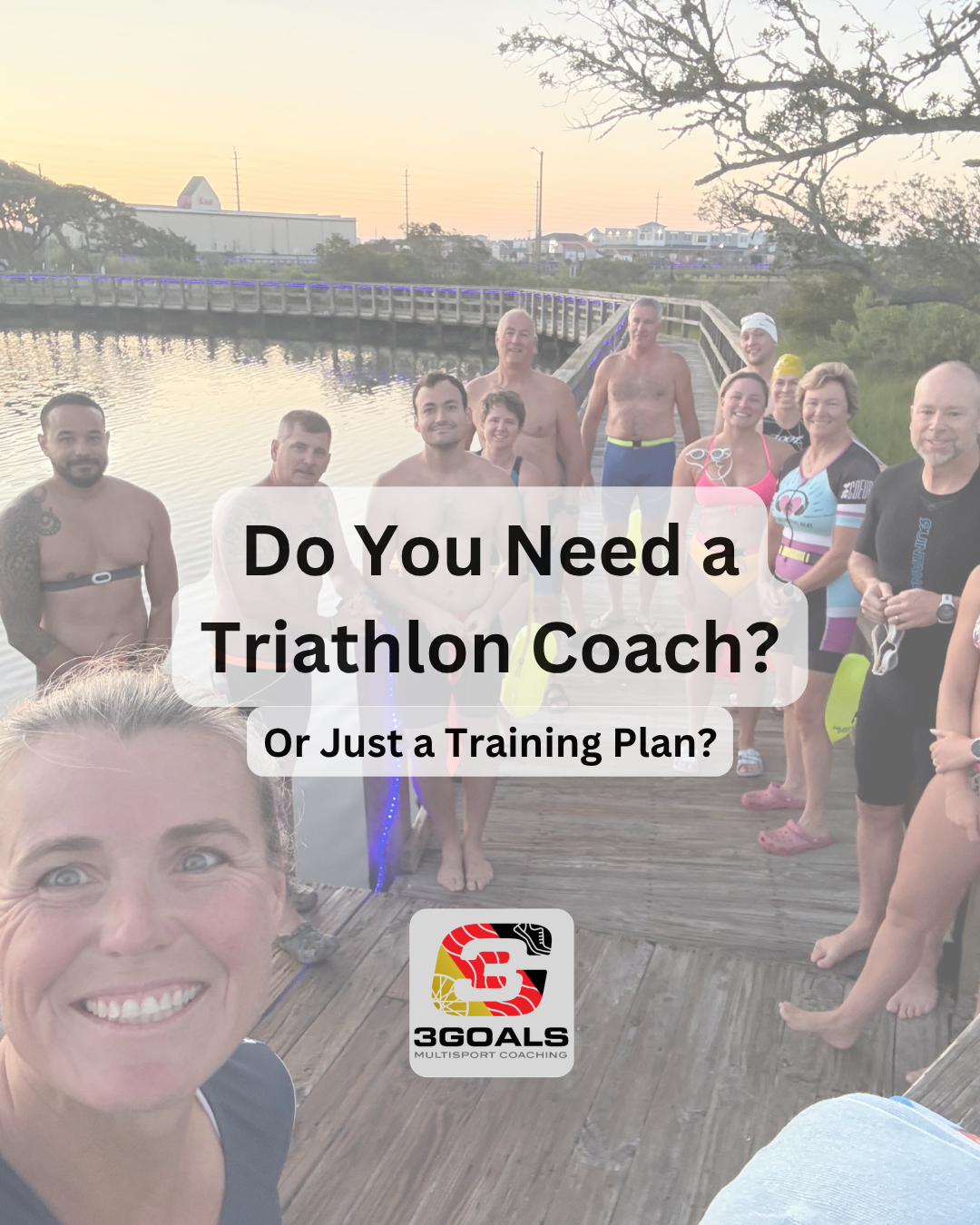
Do You Need a Triathlon Coach or Just a Training Plan?
Not every athlete needs a coach.
Some athletes do perfectly well with a structured plan, a predictable schedule, and enough experience to adjust on their own. Others are willing to work hard but do not want to spend their time constantly deciding what to do next, whether to move a missed workout, or how to change the week when life gets messy.
The real question is not whether coaching is always better.
It is whether you need a schedule—or someone who can make decisions with you when the schedule no longer fits.
Quick Answer: Coach or Training Plan?
A training plan may be enough when your schedule is predictable, your goal is straightforward, and you are comfortable adjusting your own training.
A triathlon coach may be worth considering when you want personalized planning, ongoing feedback, help adapting to real life, accountability, race strategy, and someone else to carry more of the mental load.
A useful way to think about it is this:
A plan gives you workouts. A coach helps you interpret what those workouts should become when circumstances change.
What a Training Plan Can Do Well
A good training plan can provide structure.
It can tell you:
- how often to swim, bike, and run
- how weekly volume may progress
- when to include recovery
- when to complete longer sessions
- how to build toward a specific race distance
For an athlete with a predictable schedule and a relatively straightforward goal, that may be exactly what is needed.
A plan can also be a good starting point for someone preparing for a first race. Our beginner triathlon training plan can help new athletes establish consistency without having to build an entire schedule from scratch.
A plan may be enough when:
- you enjoy managing your own training
- you understand basic training principles
- you know how to handle missed workouts
- you can evaluate your own fatigue and recovery
- your work and family schedule rarely changes
- you do not need frequent feedback
- you are comfortable making race-day decisions independently
There is nothing wrong with choosing that level of support.
Where a Training Plan Usually Falls Short
A training plan cannot see your week changing in real time.
It does not know that:
- your child was sick
- work became overwhelming
- you slept poorly for several nights
- your knee started hurting
- you missed two workouts
- your long ride left you unusually fatigued
- you suddenly have to travel
- weather made an important session impossible
That is where many athletes become unsure.
Do you move the missed workout? Skip it? Double up? Rearrange the whole week? Reduce the next session? Keep going as written?
The problem is often not motivation. It is decision-making.
And that is one of the clearest signs that coaching may be more useful than another static plan.
Five Signs You May Be Ready for a Triathlon Coach
1. You Spend Too Much Time Second-Guessing the Plan
You may know how to work hard, but still feel unsure about whether you are doing the right work.
You may constantly wonder:
- Am I training enough?
- Am I doing too much?
- Should this session feel this hard?
- Is my easy pace actually easy?
- Should I push through this fatigue?
- Is one missed workout a problem?
- How should I rearrange the week?
When every small disruption creates another decision, training starts to feel like a second job.
Some athletes enjoy that process. Others would rather focus on executing the training and let someone else manage the bigger picture.
That does not mean you are less committed.
It simply means you want your energy going toward the work itself rather than the constant planning around it.
2. Your Schedule Changes Often
Generic plans work best when life stays predictable.
Most lives do not.
A coach may be especially helpful when you regularly manage:
- work travel
- rotating shifts
- parenting responsibilities
- family events
- unpredictable work demands
- illness
- changing access to pools, gyms, or equipment
- recurring soreness or injury concerns
A coach can decide which sessions matter most, what can be removed, and how to preserve the purpose of the week without trying to save every missed workout.
That kind of adaptation is often more valuable than simply receiving more workouts.
3. You Keep Repeating the Same Mistakes
Sometimes an athlete already knows the general advice but still repeats the same patterns.
Examples include:
- starting too hard
- turning every easy session into a moderate one
- training more whenever motivation is high
- skipping recovery
- underfueling
- overbiking and struggling on the run
- ignoring early signs of pain
- arriving at races without a clear execution plan
A coach can help identify the pattern, not just the individual mistake.
That matters because the problem is often not a lack of information. It is a lack of perspective.
The same is true on race day. A strong triathlon race-day strategy can help, but personalized coaching can connect that strategy to your actual fitness, pacing tendencies, fueling needs, and experience.
4. Your Goal Feels Important Enough to Want Guidance
You do not need to be training for an Ironman to justify hiring a coach.
Your goal may be:
- finishing your first Sprint
- becoming comfortable in open water
- completing an Olympic-distance race
- returning after injury
- setting a personal best
- improving race execution
- qualifying for a championship
- training consistently around a busy life
The size of the goal does not determine whether it deserves support.
What matters is how meaningful it is to you.
New athletes may especially benefit from coaching because they are learning several skills at once: open-water swimming, transitions, equipment, pacing, fueling, and race-day logistics.
Our guide to what to expect at your first multisport race can help with the basics, while coaching can help prioritize which pieces matter most for your specific race.
5. You Want Feedback, Not Just Workouts
A calendar can tell you what was scheduled.
It cannot tell you:
- whether your execution matched the purpose
- whether your fatigue is becoming a pattern
- whether your pacing is improving
- whether your fueling needs adjustment
- whether your confidence is changing
- whether your race goal is still realistic
- whether your training should progress or pull back
Coaching becomes valuable when you want someone to look at more than completion percentages.
A good coach should add context, education, and judgment—not simply restate the data you can already see.
What Should Personalized Coaching Actually Include?
Before hiring a coach, it helps to know what you are paying for.
Individual coaching should include more than accountability.
Personalized planning
The training should reflect:
- your race goal
- your experience
- your current fitness
- your schedule
- your injury history
- your strengths and weaknesses
- your life outside of triathlon
Thoughtful adjustments
The plan should change when:
- your schedule changes
- fatigue builds
- illness interrupts training
- pain appears
- progress is faster or slower than expected
- race priorities change
Useful feedback
You should receive more than “good job.”
Feedback should help you understand what went well, what needs attention, and what should happen next.
Education
You should understand enough of the “why” to execute the plan with confidence.
That does not mean you need to become your own coach. It means the training should make sense.
Race strategy
A coach should help with more than fitness.
That may include:
- pacing
- fueling
- hydration
- equipment
- transitions
- race-morning logistics
- course-specific preparation
- decision-making under pressure
For newer athletes, practicing a simple transition setup and repeatable routine can reduce a great deal of uncertainty before race day.
Perspective
Athletes often react emotionally to a single bad workout.
A coach can help you see the broader pattern and decide whether that session was meaningful, temporary, or a sign that something should change.
Questions to Ask Before Hiring a Triathlon Coach
Before choosing a coach, ask:
- How personalized is the training?
- How often will we communicate?
- What happens when I miss a workout?
- How quickly are schedule changes handled?
- Will the coach explain the purpose behind key sessions?
- How is workout feedback reviewed?
- Does the coach help with race strategy?
- Does the coach understand my life outside of training?
- Do I feel comfortable sharing concerns?
- Can I be honest without feeling judged?
The answers should be clear before you begin.
You are not simply buying a calendar. You are entering a coaching relationship.
How to Get More Value From Coaching
Hiring a coach does not mean you need to become a perfect athlete.
In fact, pretending everything is perfect makes coaching less effective.
Your coach needs accurate information about:
- missed workouts
- pain
- fatigue
- stress
- sleep
- travel
- fueling
- confidence
- schedule conflicts
- workouts that felt too hard or too easy
Useful feedback does not have to be long.
A few honest details can completely change the next decision.
Your coach cannot adjust for information they do not have.
It also helps to ask questions. Trusting the process does not mean staying silent when you are confused.
The strongest coaching relationships are built on communication, trust, and collaboration—not flawless workout completion.
What About the Team?
For many athletes, coaching also includes community.
A good team should give you people to train beside, not people you feel pressured to keep up with.
You do not need to be the fastest or most vocal person to contribute.
You can show up by:
- encouraging someone else
- asking a question
- sharing a win
- admitting when something is hard
- joining a group workout
- attending a call
- welcoming someone new
- celebrating progress that is not a podium or personal record
Strong teams celebrate first open-water swims, consistent weeks, returns after illness, better fueling, smart recovery, and the courage to start.
Community should help athletes feel supported, not compared.
Coach or Plan: A Simple Decision Guide
Choose a training plan when:
- your goal is straightforward
- your schedule is predictable
- you enjoy managing your own training
- you know how to adjust missed sessions
- you do not need ongoing feedback
Consider a coach when:
- your schedule changes often
- you want someone else to manage adjustments
- you keep repeating the same problems
- you want personalized feedback
- your goal feels important
- you need help with race execution
- you want accountability and community
- you do not want training decisions to become your second job
The Bottom Line
A training plan can be a useful tool.
A coach becomes valuable when you need more than a schedule.
You may be ready for coaching when you are willing to do the work but want help deciding what that work should be, how it should fit your life, and what should change when real life interrupts the original plan.
You are not hiring a coach because you are incapable of doing hard things.
You are hiring a coach so you do not have to figure out every hard thing alone.
Wondering Which Level of Support Fits You?
Explore personalized triathlon coaching with 3 Goals Multisport to learn how training can be built around your goals, schedule, experience, and real life.
Not ready for coaching? Start with the free triathlon training plan and begin building consistency with a structured approach.
You can also watch or listen to Episode 6 of Coach Erin Says, When Is It Time to Hire a Triathlon Coach?, for the conversation that inspired this guide.
Train with purpose, race with confidence, and make yourself proud.
Leave a Reply